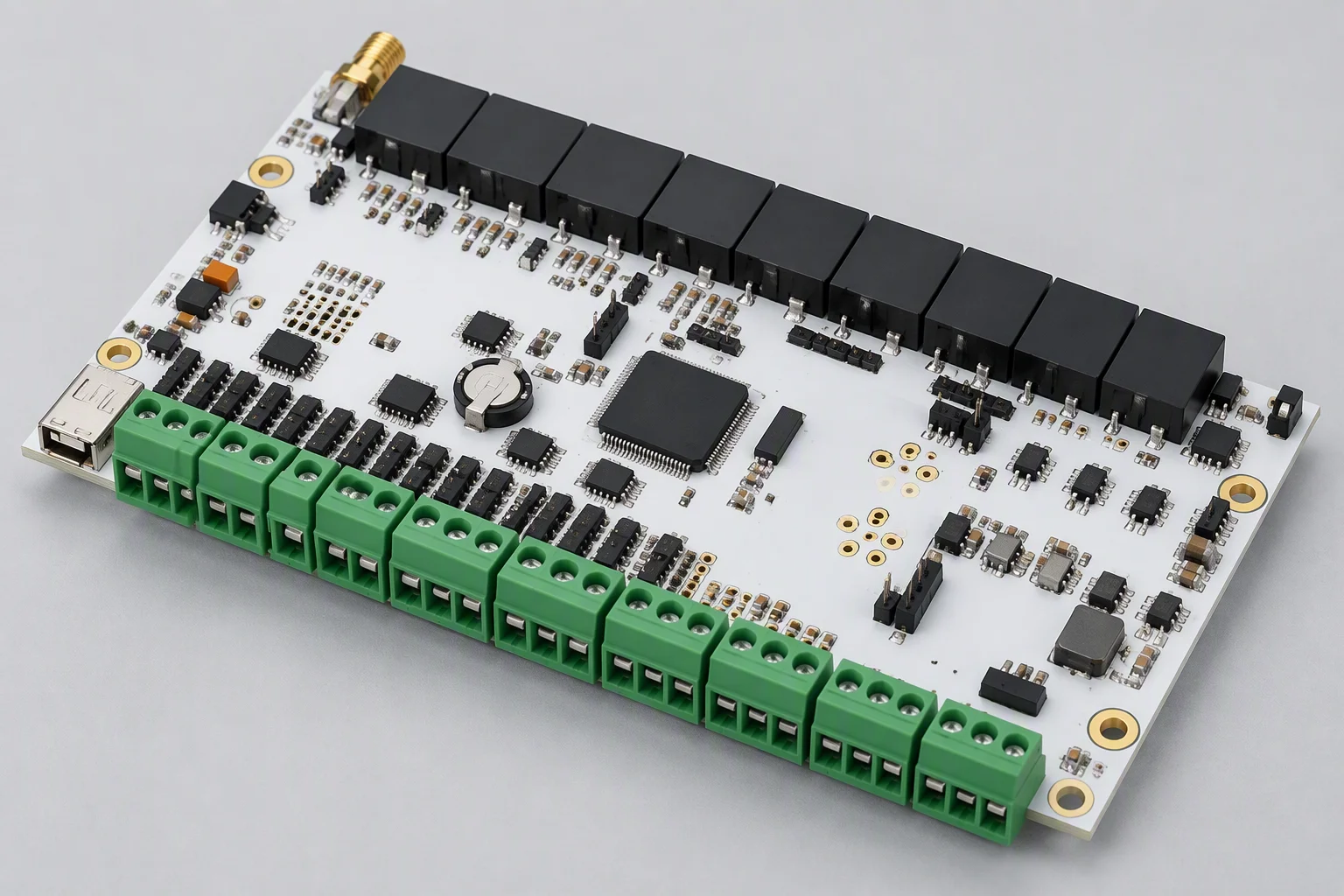
Industrial Control & Automation
Judged on year six, not year one: a discontinued MCU, a −40 °C cold start, a 24 V I/O line isolated from logic ground.
Industrial control detailIndustries
Your industry does not change our price list. It changes the certification you are audited against, the laminate, the copper weight and the inspection grade on the traveller. We have built to those rule sets from Shenzhen since 1998 and ship to 60+ countries under an ISO 9001:2015 certified system audited annually by SGS.
Scale
One plant, one container, one inspection chain. The numbers below are the range every industry page draws from.
Choose your rule set
Each card states the pain points, the certification codes and the material or process answer for that industry. The detail pages carry the same logic at working depth.
Judged on year six, not year one: a discontinued MCU, a −40 °C cold start, a 24 V I/O line isolated from logic ground.
Industrial control detail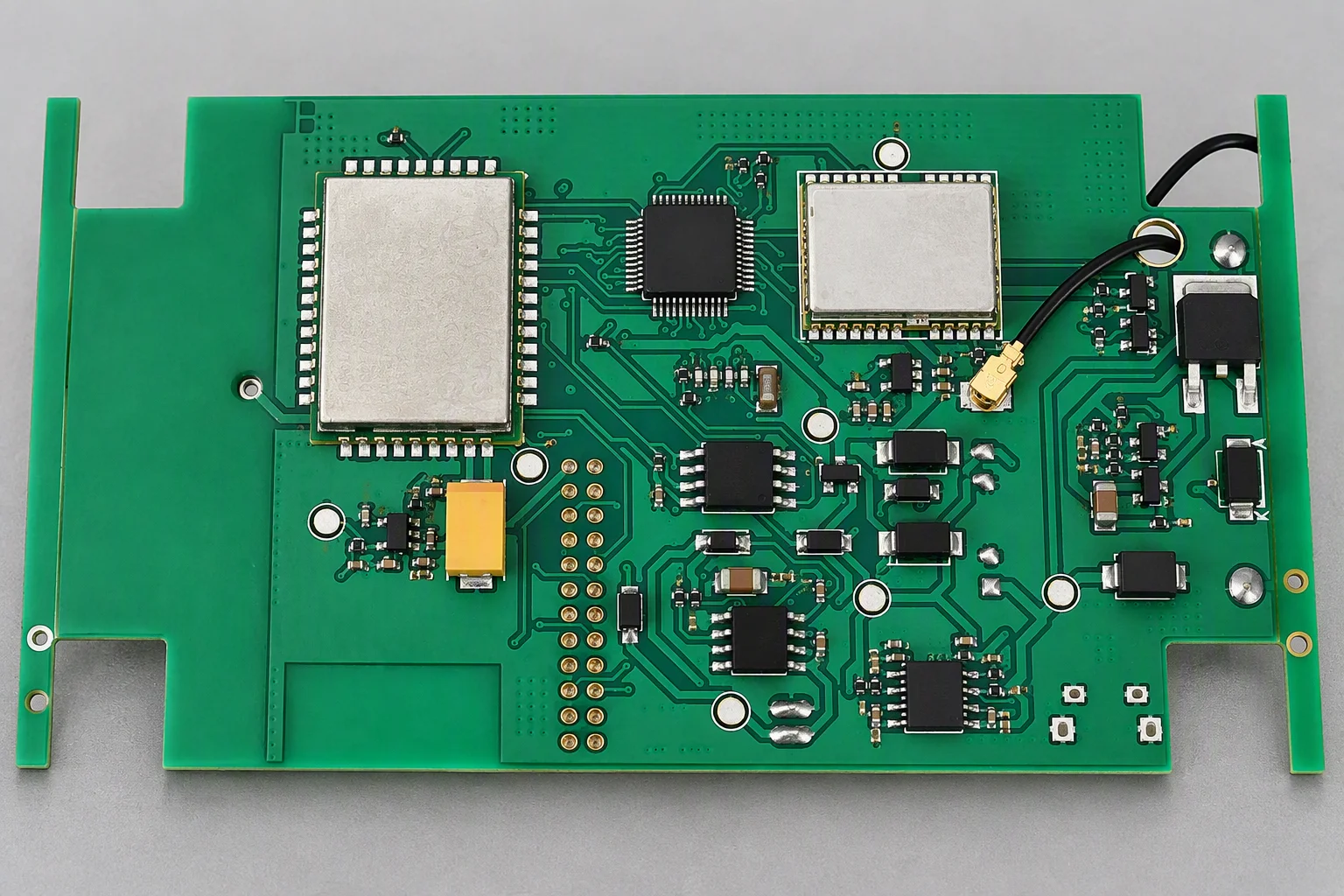
Wireless programs are lost in certification queues, not on the assembly line.
IoT & wireless detail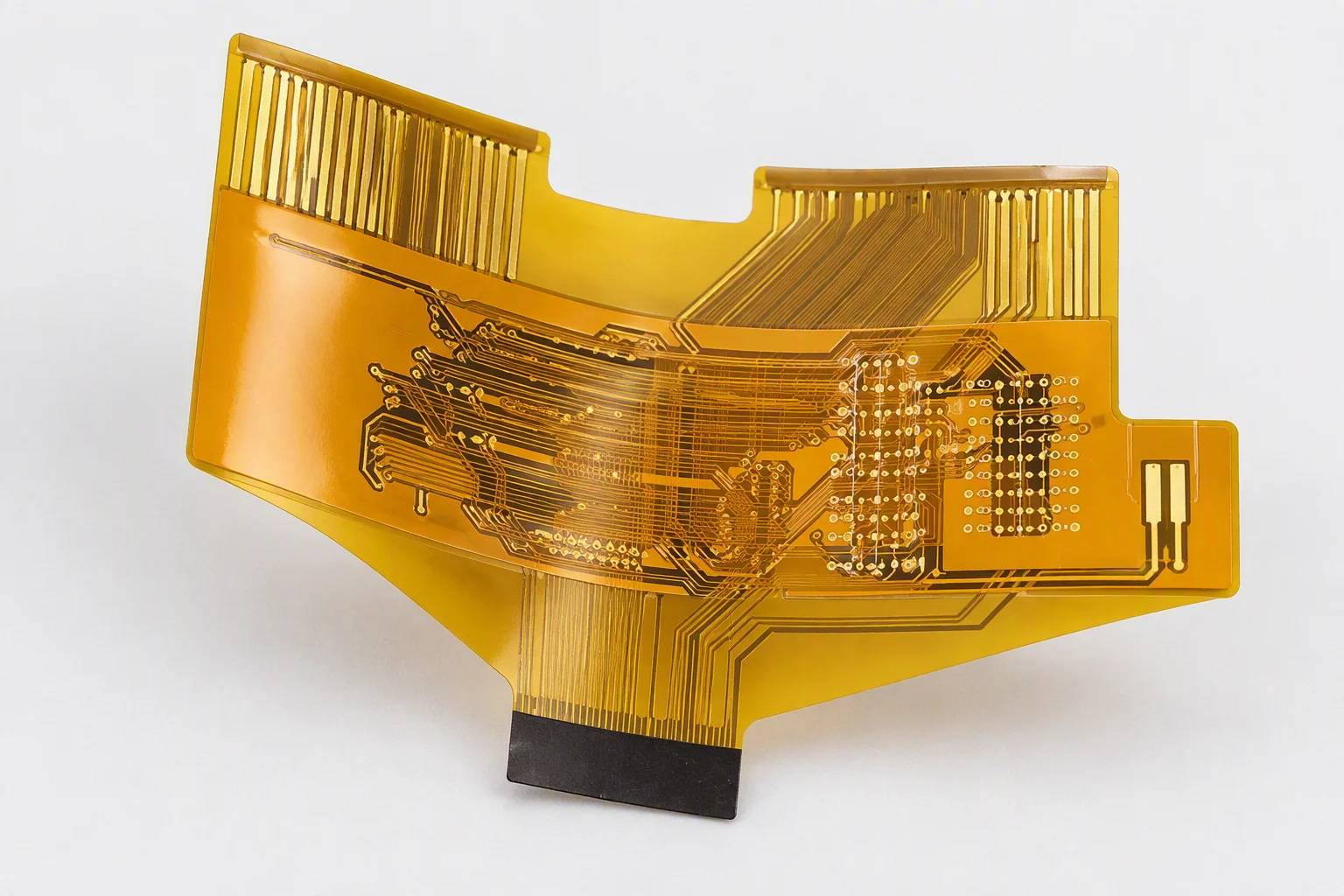
Three rule sets overlap on every medical build, and the spacing rules decide the laminate.
Medical device detail
Tier-1 sourcing starts with documents, delivered with the lot rather than on request.
Automotive & EV detail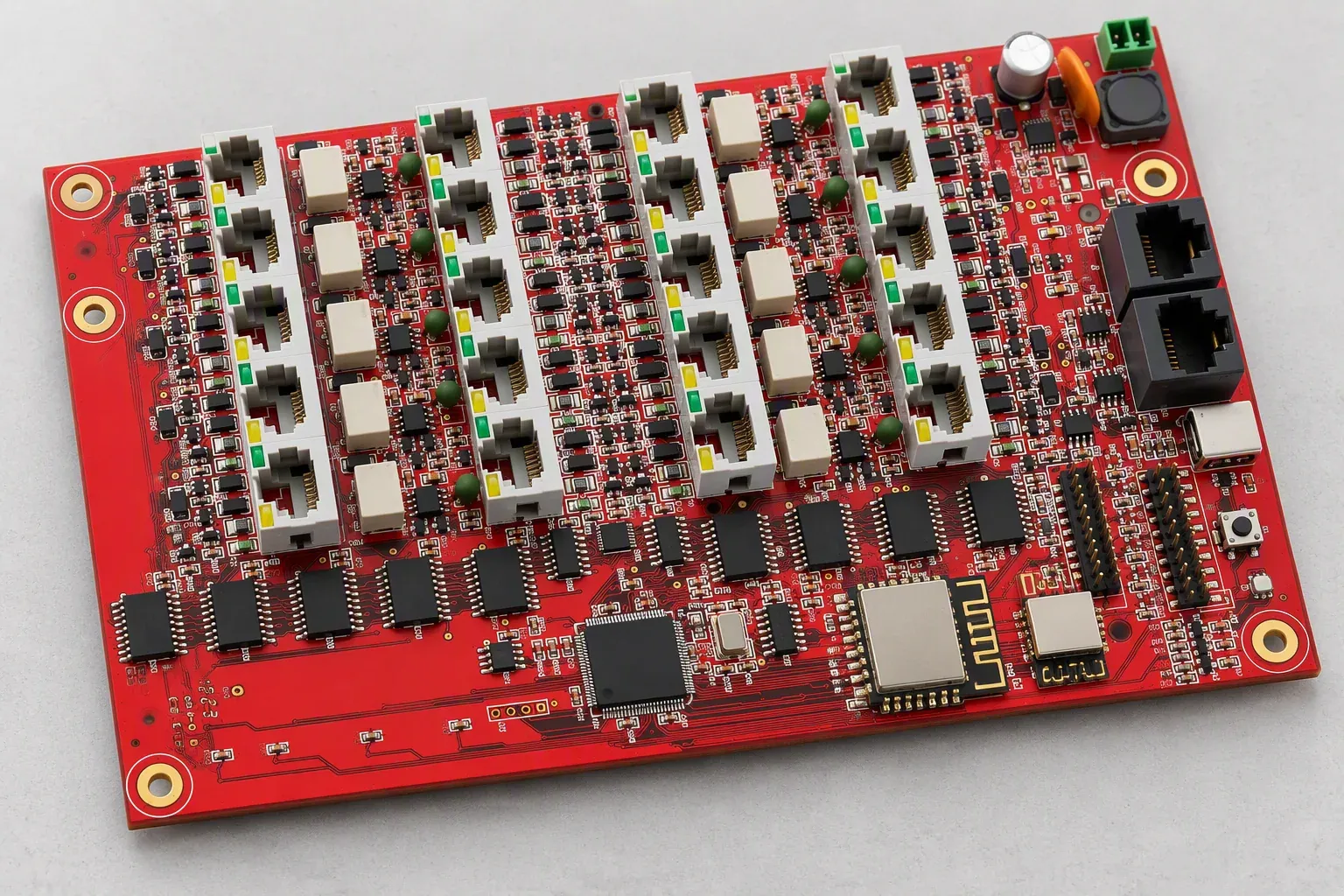
The volume segment: 10,000-piece runs where a cent of material and a retail window set the schedule.
Consumer & smart home detail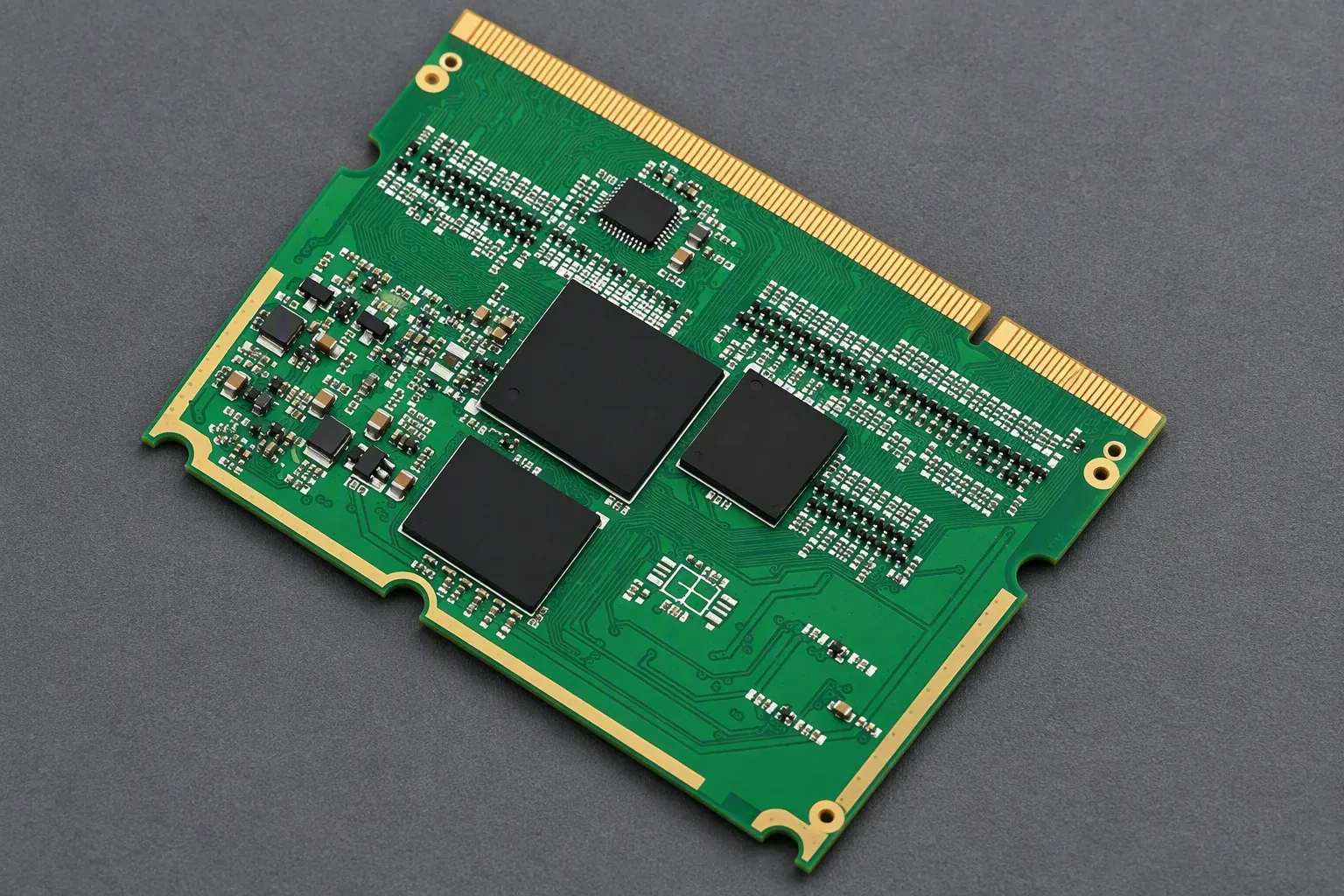
A 400–800 V DC bus rewrites the design rules, and certification cost dwarfs the board.
Power & energy detail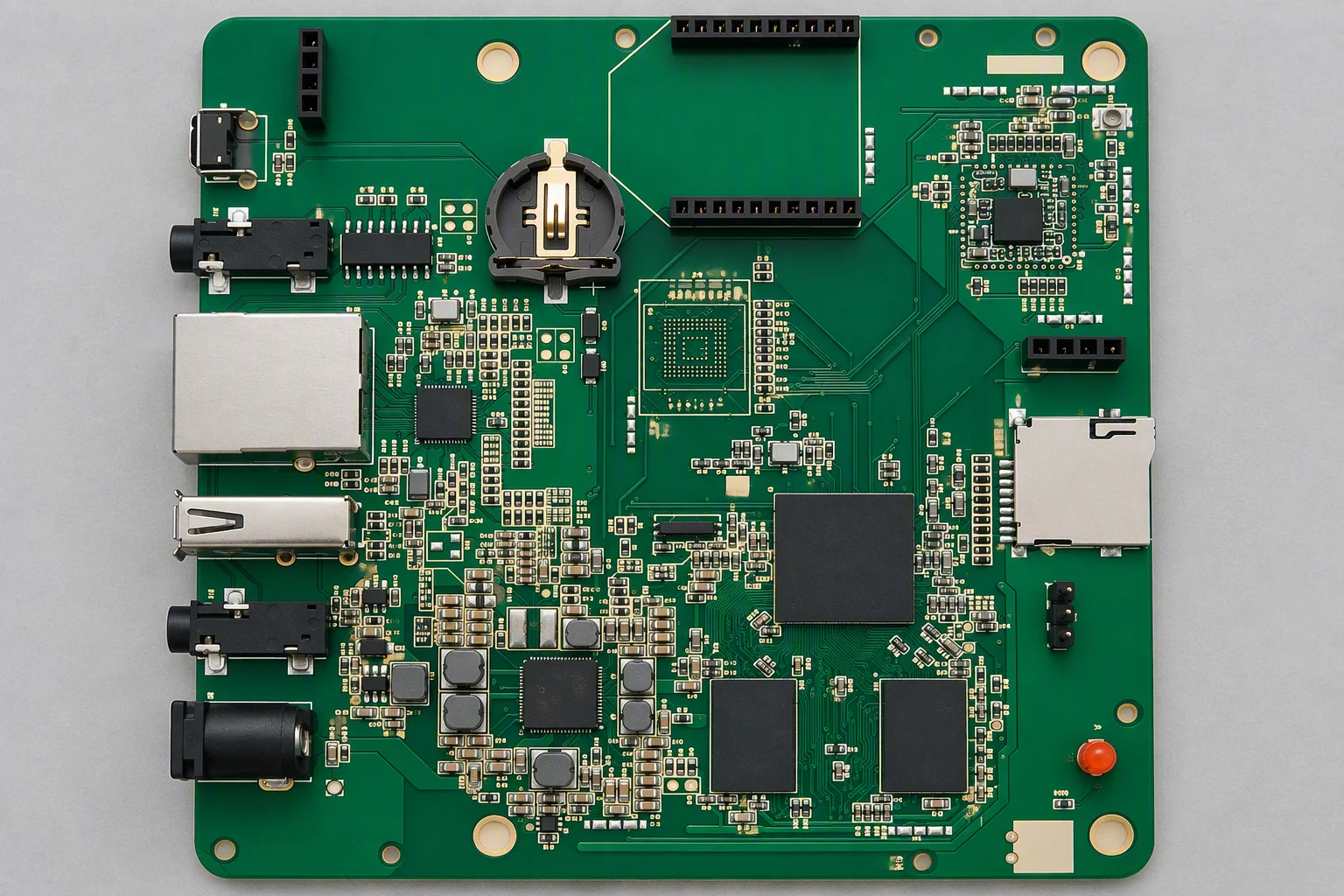
Growth sits in low-loss, high-layer-count boards rather than commodity FR-4.
Telecom & networking detail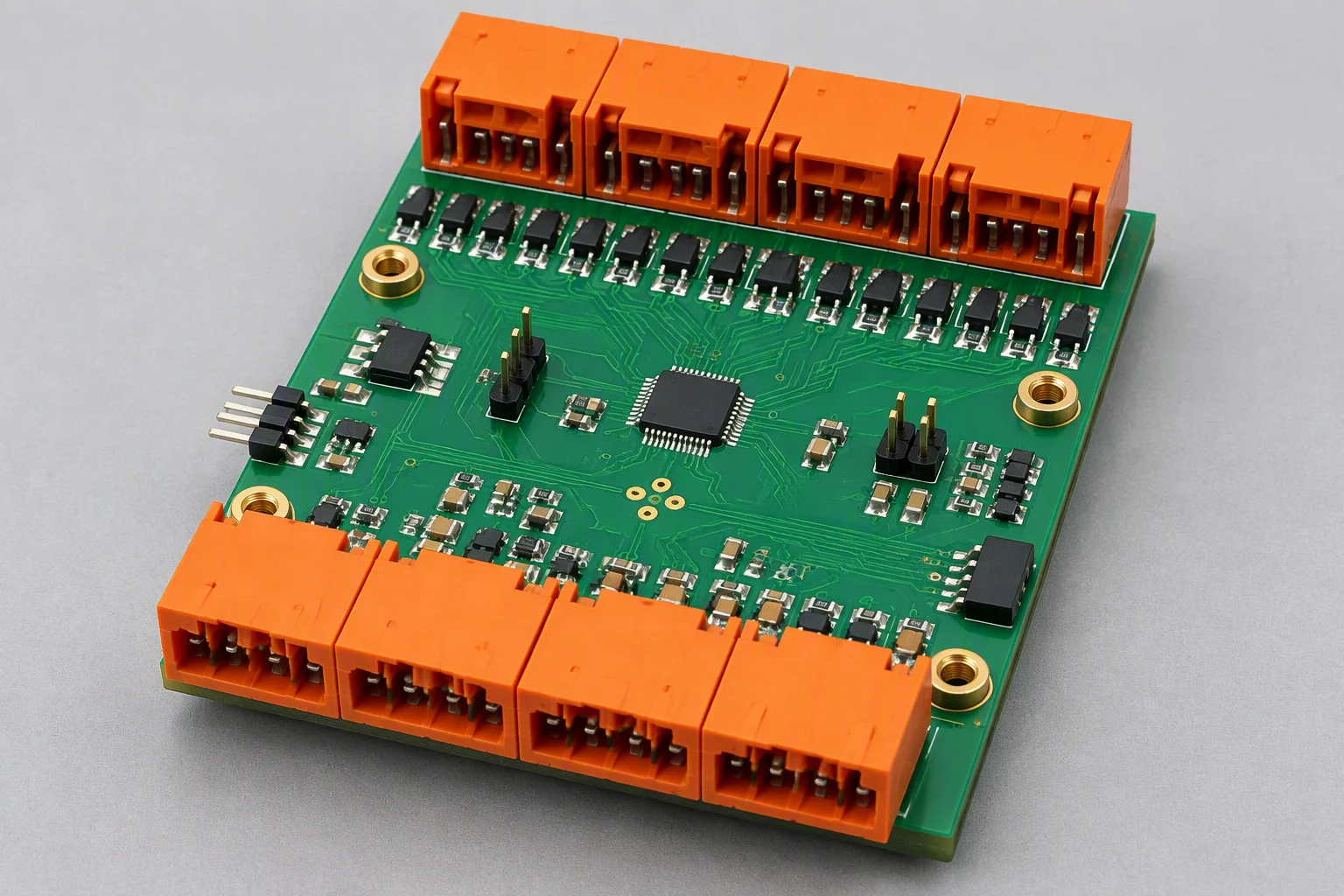
Mixed-technology boards for installed bases that have to be supported for a decade.
Security & building detailCross-industry matrix
Read down a column to see where your program sits, or across a row to see what changes when the certification, the laminate and the inspection grade move together.
| Industry | Certification / standard | Material | Key process | Typical layers | Thermal or voltage window |
|---|---|---|---|---|---|
| Industrial control | UL 508A / UL 50 · IEC 61508 (SIL) · IEC 61131-2 · CISPR 11 | High-Tg FR-4, Tg 170–180 °C | 2–6 oz heavy copper · IPC-CC-830 coating · ±10 % impedance | 2–8, HDI by review | −40 … +85 °C duty, extended to +105 °C |
| IoT & wireless | RED 2014/53/EU + EN 18031 · FCC 15B / 15C | Rogers RO4350B, Dk 3.48 | 50 Ω / 100 Ω impedance · 15–20 mm RF-to-digital gap · 1+N+1 HDI | 4–6 | Class 2 inspection is sufficient here |
| Medical devices | IEC 60601-1 Ed. 3.1 (2005 + A1:2012, consolidated with A2:2020) · ISO 13485 process capability · IPC-6012 Class 3 | High-CTI laminate, comparative tracking index (CTI) at Material Group I | 2× MOPP barrier · serialised traceability · ionic cleanliness | 4–12 incl. rigid-flex | 4,000 VAC withstand · 5.0 mm clearance / 8.0 mm creepage |
| Automotive & EV | IATF 16949 process capability + PPAP / IMDS · AEC-Q100 / Q200 | High-Tg FR-4, Tg ≥170 °C | Thermal vias under power devices · 6× 260 °C reflow · IPC-1782A M3 | 4–8, power stages by review | −55 … +125 °C, 1,000 cycles |
| Consumer & smart home | FCC 15B SDoC · CE / UKCA · UL 62368-1 · UL 94 V-0 | 4–6 layer FR-4, cost-optimised stack | Single-sided assembly · panelisation · six solder-mask colours | 4–6 | 1,000–50,000 units per year |
| Power & energy storage | UL 1741 (+SA/SB) · UL 9540 / 9540A · IEC 62109-1 | Aluminium IMS · Material Group I (CTI ≥ 600) | 2–6 oz copper · 400–800 V DC spacing · epoxy or polyurethane potting | 2–8 | 400–800 V DC bus, Class 3 documentation |
| Telecom & networking | FCC 15B · EN 55032 / 55035 · IEEE 802.3af/at/bt · NEBS Level 3 | Megtron 6 (Dk 3.40) · Taconic | Back-drilling · ±5 % impedance on premium builds · per-lot TDR coupon | 8–20+ | 85–90 Ω / 100 Ω differential channels |
| Security & building automation | UL 294 Ed. 8 · EN 50131 Grade 2/3 · BACnet BTL | High-Tg FR-4, 170 °C+ | RS-485 differential + IEC 61000-4-5 surge · PoE copper by wattage class | 4–8 | PoE 15.4 W to 90 W per port |
Inspection grade is a cost decision rather than a virtue: Class 2 carries verticals 2, 5 and 7 without extra cost, while Class 3 documentation is a purchasing requirement in medical, automotive, energy storage and the higher security grades.
Shared quality base
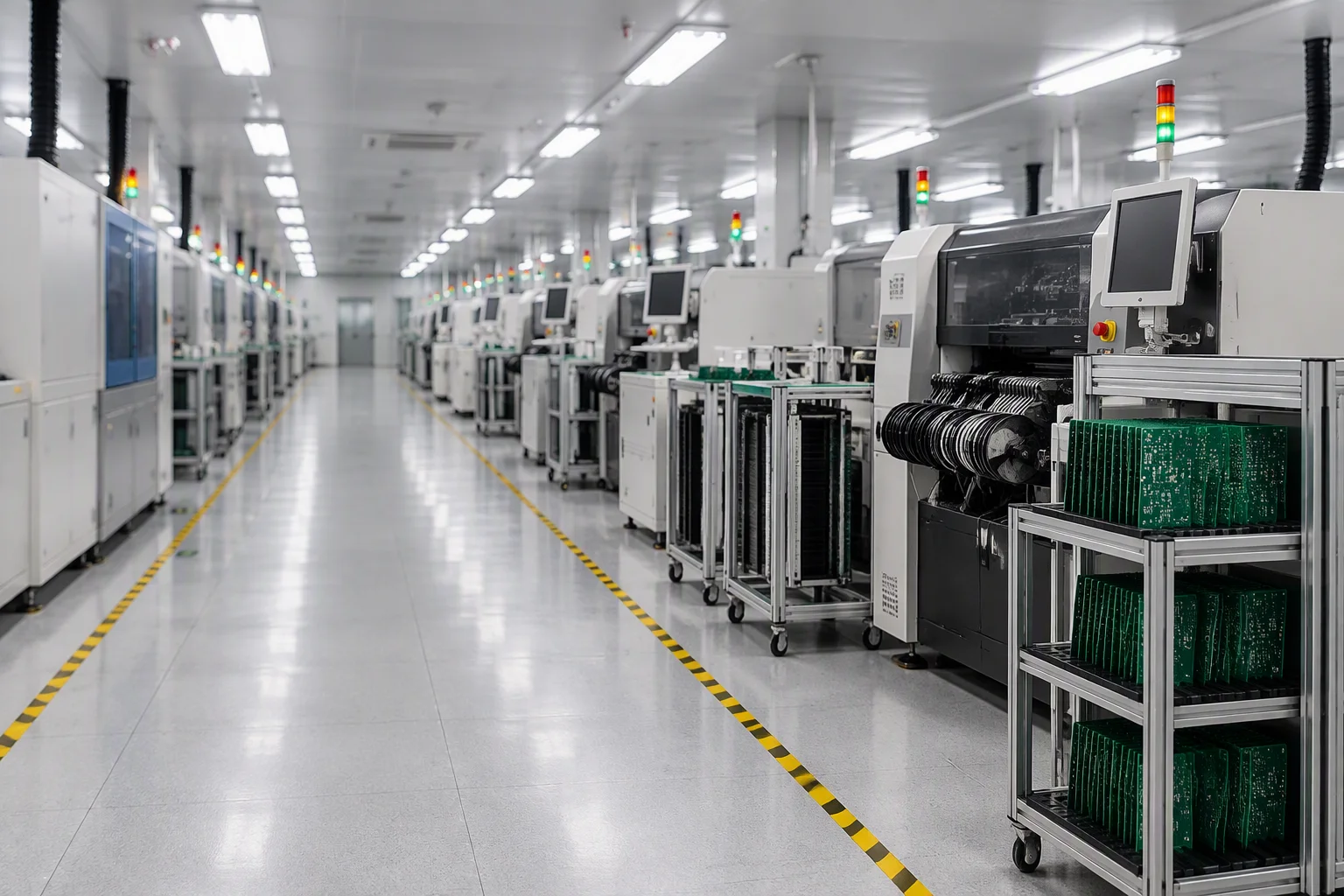
Whatever the rule set, a board leaves this plant through one inspection chain. These are the ten stations every industry page refers back to.
Bare boards inspected against the drawing with a test coupon; component date codes and quantities checked.
Paste volume, area, height and alignment measured; out-of-tolerance prints trigger an automatic wipe and reprint.
100 % of boards on every SMT line, checking presence, polarity, offset, tombstoning and joint shape.
BGA, QFN and LGA voids judged to J-STD-001, with a minimum of five boards taken from each lot.
Four-head Takaya APT-1500F proves continuity and isolation without waiting for a bed-of-nails fixture.
Agilent i3070 covers 3,072 test points: opens, shorts, component values and diode orientation.
A purpose-built fixture powers the board, loads firmware and exercises the interfaces the end product uses.
Final visual inspection per IPC-A-610 Class 2 or 3, stamped and serialised, with a photo record per board.
Packaging, labelling, quantity and shipping documents sampled to AQL ANSI/ASQ Z1.4 (general inspection level II, single sampling, normal severity, AQL 0.65 for major defects) before the carton closes.
Board serialisation, material certificates, monthly quality review and 8D/CAPA follow-up when something deviates.
Inside an industry page
Every industry page follows the same argument, rewritten in that industry's own vocabulary, here is what each stage answers.
What actually breaks programs in your segment, an end-of-life MCU, a 4,000 VAC barrier, a −55 °C cycling requirement: each with a number attached.
The standards your auditor or customer will name: IEC 60601-1 Ed. 3.1 (2005 + A1:2012, consolidated with A2:2020), IPC-6012 Class 3, AEC-Q100, IEC 61508 (SIL), CISPR 11, turned into a short requirement list.
The materials, copper weights, impedance tolerance and coating thicknesses we hold as standing options, stated as parameters rather than adjectives.
What we hold, what we document and what we support: ISO 9001:2015 certified, UL 796 recognised, RoHS and REACH compliant, PPAP and IMDS files, export-control-aware procedures.
A board of your type described as a project, stackup, copper, finish and inspection outcome. No customer names, no logos, no invented performance figures.
Gerber, BOM and pick-and-place in; engineering review, DFM report and price back within 24 hours. No MOQ, one board or fifty thousand on the same lines.
Quotation in 24 hours
Send Gerber, BOM and pick-and-place coordinates. An engineer reviews the stackup, the copper and the inspection grade, then replies with a DFM report and a price within one working day. No MOQ.
Send your Gerber, BOM or a plain description. An engineer, not a sales script, reviews it and replies within one working day. NDA on request.