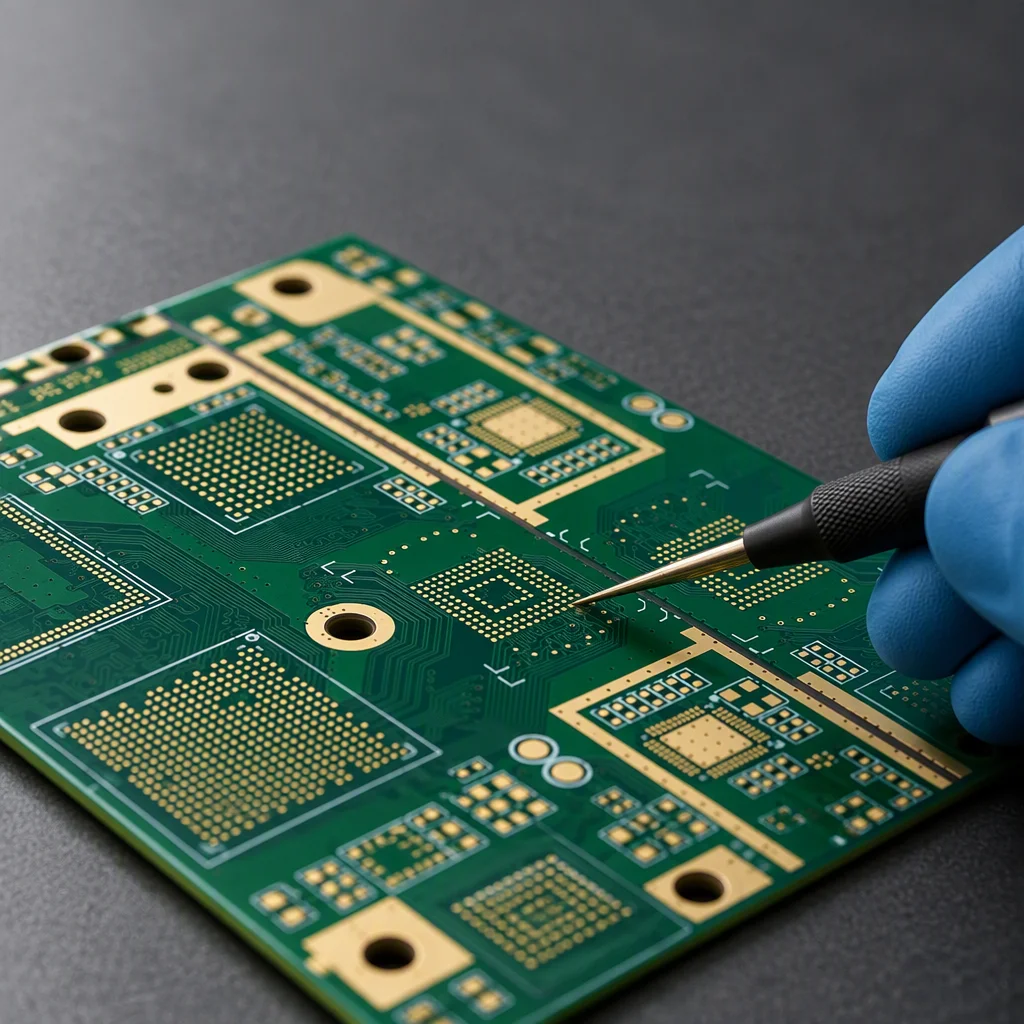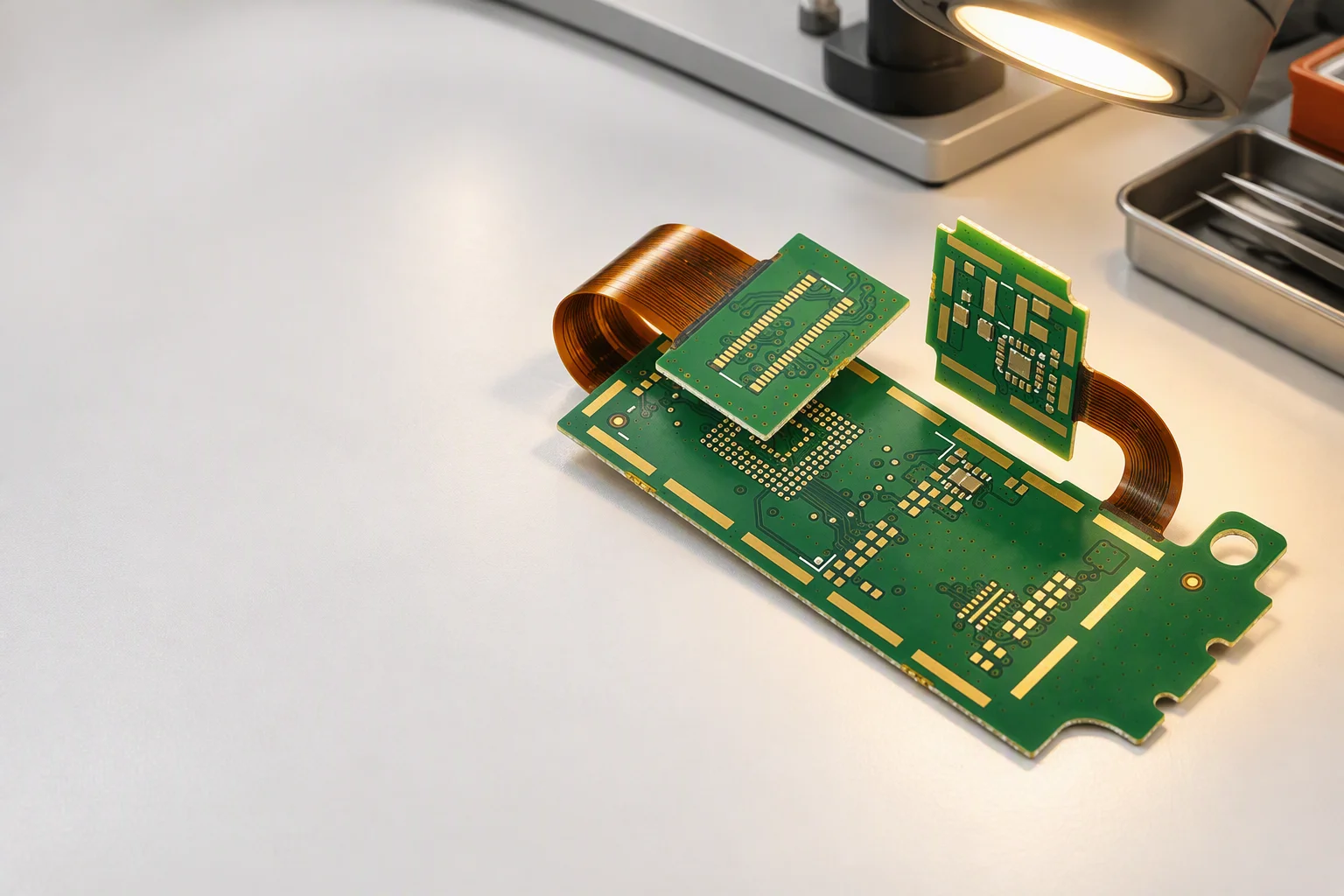
Rigid-flex medical board with its flex tail arcing up from the rigid core and fine-pitch components in sharp focus

Medical devices & wearables

Builds that stay auditable after the design freeze

Three rule sets overlap on every medical board: IEC 60601-1 Ed. 3.1 (2005 + A1:2012, consolidated with A2:2020) for safety and spacing, ISO 13485 for the quality system and traceability, IPC-6012 Class 3 for the bare board. We work as a medical-grade process capability, serialisation, lot-to-serial traceability and the documentation that proves both, on an ISO 9001:2015 certified system audited annually by SGS.

ISO 13485 process capability Lot → board serial traceability IPC-6012 Class 3 No MOQ, from 1 board
How the records are kept

What medical programs get wrong

Three decisions that are expensive to take late

A medical board is not harder to assemble than an industrial one. It is harder to document, harder to change and far harder to recall, which is where these three problems start.

Pain 01 · traceability

A record that stops at the batch, not the board

One assembled medical board consumes 300–800 components, and a single unrecorded reel splice is enough to make a field complaint untraceable. Records expected under 21 CFR Part 820 push most programs to IPC-1782A level M3; the applicable level is agreed at NPI granularity: material lot, production batch, board serial and test result joined in one retrievable record. Retrofitting that discipline after a design freeze means re-qualifying the assembly.

Pain 02 · insulation

Two means of protection, five millimetres of air

Reinforced insulation between a patient connection and mains is a spacing problem before it is a component problem: 2 x MOPP at 250 V AC working voltage requires 4,000 VAC withstand withstand with 5.0 mm clearance and 8.0 mm creepage, and the creepage is reached with a 1.5 mm milled slot instead of by spreading the circuit out. PD2 insulation also lifts the laminate to comparative tracking index (CTI) at Material Group I, where general-purpose FR-4 is typically Material Group IIIa.

Pain 03 · cost & documentation

Disposable economics with a 4–8 week paper tail

Single-use devices are cost-sensitive in a way implants are not, yet Class 3 fabrication, 5 mil annular ring, plated copper of 25 µm or more, two microsections per lot, carries an industry-typical 15–25 % bare-board cost premium on top. A complete package of traceability records, CoC, test data and material declarations lands four to eight weeks after the design freeze.

Regulation → manufacturing response

One requirement per line, and the evidence that answers it

Every row below is written the way an auditor reads it: the clause first, then what we physically do, then the record that proves it happened.

Two means of patient protection, mains side and patient-connected side separated by a 4,000 VAC barrier with 5.0 mm clearance through air and 8.0 mm creepage routed around a 1.5 mm milled slot on comparative tracking index (CTI) at Material Group I laminate comparative tracking index (CTI) at Material Group I laminate Mains side AC input, switching stage Patient side applied part, sensor front end 5.0 mm clearance through air 2× MOPP barrier · 4,000 VAC withstand milled slot, 1.5 mm 8.0 mm creepage along the surface, routed around the slot
Medical regulations and the manufacturing response held in place for each one
Regulation or standard What it demands Our manufacturing response
IEC 60601-1 Ed. 3.1 (2005 + A1:2012, consolidated with A2:2020) 2× MOPP at 4,000 VAC withstand; 5.0 mm clearance, 8.0 mm creepage; PD2 laminate High-CTI laminate (≥400 V) with spacing drawn on the fabrication drawing and a 1.5 mm milled slot where creepage cannot be bought with distance
ISO 13485 Quality system, serialisation and traceability documentation for every delivered unit Process capability with serialisation: material lot → production batch → board serial → test record, released with the shipment
IPC-6012 Class 3 Minimum 25 µm plated copper, 5 mil annular ring, conductor reduction capped at 20 % Class 3 fabrication with two microsections per lot and thermal stress at 288 °C for 10 s
J-STD-001 Void and fillet criteria for joints that cannot be inspected visually Nordson DAGE XD7600NT digital X-ray on a minimum of 5 boards per lot, voiding judged to J-STD-001
IPC-A-610 Class 2 & 3 workmanship Documented final acceptance criteria and trained inspectors Final visual inspection with inspection stamp, serial number and a digital photo record per board
Cleaning & coating Residue limits before coating; moisture and contamination protection afterwards Ultrasonic plus DI water cleaning held to ≤1.56 µg/cm² NaCl equivalent, then IPC-CC-830B coating, acrylic, silicone, polyurethane or parylene 5–50 µm

Traceability chain

The traceability chain from a reel to a shipped unit

A returned device should be answerable with one query: which material lot, which production batch, which board serial, which test result and which certificate left with it.

Traceability chain. Material lot, production batch, board serial, test record and certificate of conformance joined into one record retrievable by board serial under IPC-1782A level M3; the applicable level is agreed at NPI Material lot supplier, date code Production batch SPI, AOI, X-ray data Board serial laser Data Matrix Test record ICT, FCT pass/fail CoC travels with goods IPC-1782A level M3; the applicable level is agreed at NPI granularity, one record per board serial, retrievable for the retention period agreed with your quality team.
  • Material lot: supplier, date code and incoming inspection result recorded against the reel or tray that fed the line
  • Production batch: SPI print report, AOI images and the X-ray plates of that lot kept together
  • Board serial: laser-marked Data Matrix where UDI or unit-level marking is required, otherwise a serial label
  • Test record: ICT covering 3,072 test points and a custom FCT fixture write pass/fail against the serial
  • Certificate: CoC, test data and RoHS/REACH declarations packed with the goods, not sent afterwards
  • Retention: records kept for the period agreed in the quality agreement, with NDA confidentiality on your files from first contact

Materials & back-end process

Choose the substrate, then the coating

Wearables, single-use disposables and bench instruments do not share a substrate or a finish. These are the combinations we laminate, assemble and coat in-house.

FR-4, Tg 130–180 °C High-Tg FR-4, ≥170 °C Polyimide flex Rigid-flex Aluminium IMS Acrylic coating 25–75 µm Silicone coating 50–210 µm Parylene 5–50 µm
  • High-Tg laminate as the default for lead-free reflow. Peak 245–260 °C sits outside the window of a standard 130–140 °C material, so Tg ≥170 °C is the safer starting point for anything that will be reworked.
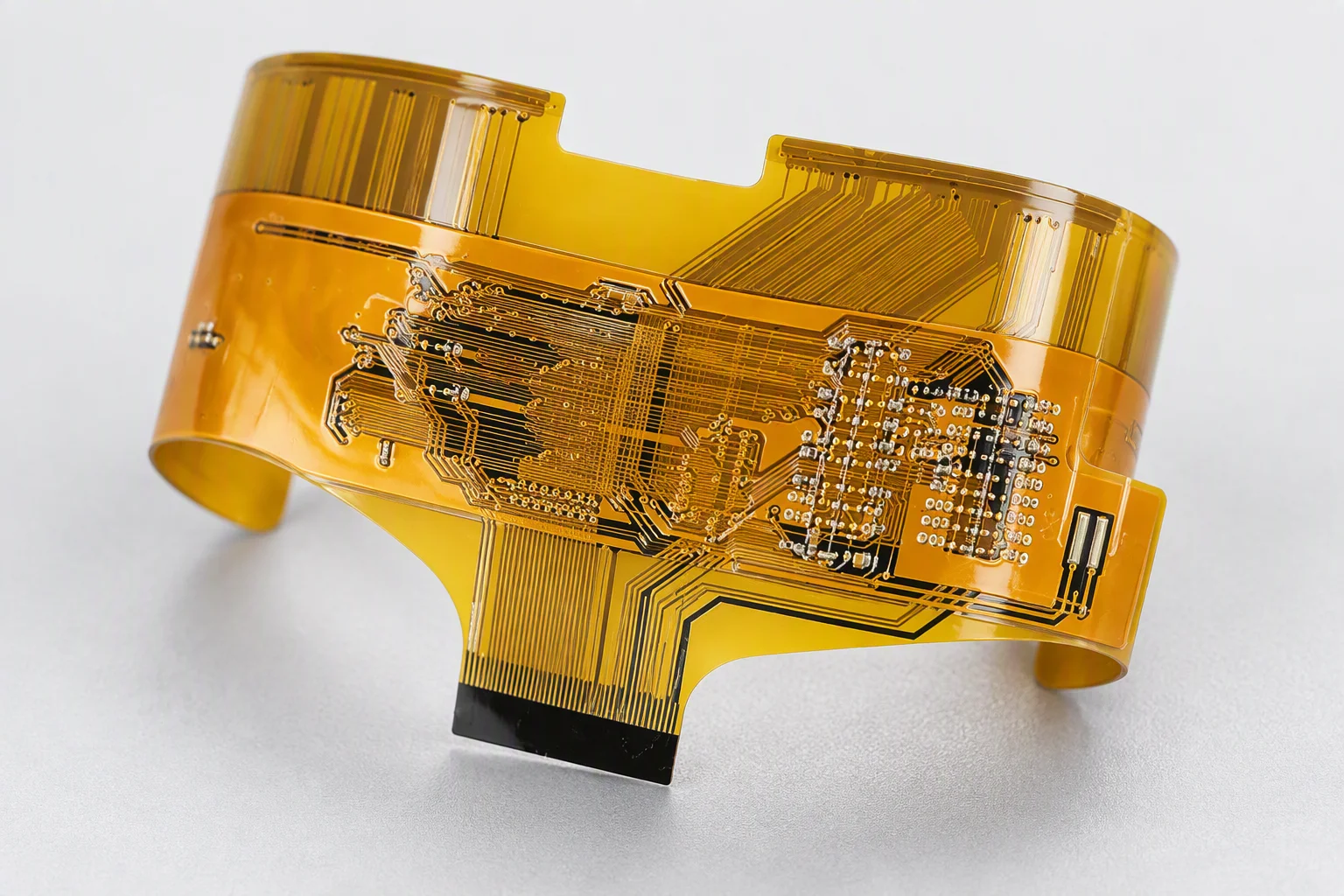
  • Polyimide flex and rigid-flex for wearables. The flexible circuit and the rigid sections are laminated in one build, which removes a connector and a solder joint from the most-bent part of the assembly.
  • Aluminium-backed IMS where heat has to leave the board, used for LED rings, sensor heaters and power stages that would otherwise derate inside a sealed enclosure.
  • Conformal coating to IPC-CC-830B, applied selectively. Connectors, test points, sensors and battery contacts are masked so the coating protects the circuit without blocking the interface.
  • Cleaning before coating, measured. Ultrasonic plus DI water, with ionic cleanliness held to ≤1.56 µg/cm² NaCl equivalent so residue does not sit under the coating.
  • Encapsulation where the assembly is potted, epoxy or polyurethane, chosen against the thermal and mechanical duty of the enclosure rather than by habit.

System & compliance status

Stated exactly as it stands, because your auditor will check

We support your FDA and CE MDR submissions with process documentation and records. The clearances belong to your product; the system status below is ours, worded precisely.

ISO 9001:2015 certified ISO 13485 process capability environmental management practices (not certified to ISO 14001) IPC-A-610 Class 2 & 3 workmanship IPC-6012 Class 3 RoHS & REACH compliant Export-control-aware procedures

ISO 9001:2015

Certified by an accredited body and audited annually by SGS, covering design, manufacturing, assembly and test.

ISO 13485

Process capability with serialisation and full traceability documentation, including records retained to the period agreed in the quality agreement.

ISO 14001

Environmental management practices in operation, process chemical handling, waste routing and lead-free production.

RoHS & REACH

Compliant materials with declarations available per board, plus a 3TG conflict-minerals policy and CMRT on request.

Full scanned certificate package released on request.

Application case

A rigid-flex wearable board with a serialised record

A body-worn monitoring assembly built as a project type: a rigid-flex stack with a polyimide tail to the sensor, 01005 passives around the analogue front end, a laser-marked Data Matrix for unit-level traceability and a selectively coated surface that leaves the battery contacts and test pads open.

  • Substrate: rigid-flex with a polyimide tail, laminated as one build rather than two boards and a connector
  • Density: 01005 passives and fine-pitch sensor packages placed at ±25 µm accuracy
  • Protection: selective IPC-CC-830B coating, masking the sensor window and the battery contacts
  • Verification: a custom FCT fixture checks the analogue front end and the radio link before packing
  • Outcome: 3D AOI on 100 % of boards, X-ray on a minimum of 5 boards per lot, AQL ANSI/ASQ Z1.4 (general inspection level II, single sampling, normal severity, AQL 0.65 for major defects) sampling at shipment, and a per-board record retrievable by serial
Wearable flex circuit bent into a wrist-like curve with its conformally coated surface catching the light
SMT assembly hall aisle with placement machines, feeder carts and green PCB panels stacked on a trolley at the Saturn PCBA plant

Quotation in 24 hours

Send the drawings, the spacing table and the traceability spec

Gerber, BOM, assembly drawing and your test specification. If the files are sensitive, start with an NDA, non-use, non-disclosure and non-circumvention, and an engineer will review the build and reply within one working day.

[email protected]
Quote in 24 h