An access controller or a building gateway is installed once and then
expected to be orderable for a decade. That makes the bus interface, the coating and
the component lifecycle the real design constraints, not the feature list.
KNX, RS-485 and 24 V interfaces with isolated, surge-protected front ends
A ten-year supply plan: lifecycle monitoring, last-time buy and written PCN in place of a verbal promise
5,000+ approved suppliers and 13,000 part numbers a month, with no MOQ on repeat orders
4–8 layer mixed-technology boards, to 58 layers on request, at IPC-A-610 Class 2 or Class 3
Riser cupboards, plant rooms and air-handling spaces are not
laboratories. The three failure modes below are why this industry buys build class
and coating rather than the board that merely works on a bench.
01
−20 … +70 °C, condensing
Moisture plus bias is a corrosion cell
A controller in a riser or a plenum chamber sees −20…+70 °C with
condensation, not a clean bench. Moisture on a biased board is an
electrochemical migration path, and the failure arrives as creeping leakage or
intermittent resets long before anything looks burnt.
02
3 interface families, one board
A bus pair that runs between buildings is an antenna
KNX, RS-485 and 24 V field wiring leaves the enclosure, so surge and ESD
arrive on the connector rather than on the mains. Without isolation, a
partitioned ground and IEC 61000-4-5 surge protection at the interface, the
transceiver is the fuse, and the relay drive is next.
03
Year 1 to year 10
Parts retire before the product does
A reader listed in year one is expected to be re-orderable in year ten. In
between, the microcontroller, an optocoupler or a connector goes end-of-life,
and a board that cannot be re-built is a product that cannot be sold,
whatever the field population needs.
Interface and environment
Bus, barrier, board, answered in that order
The build class follows the listing, not the budget. A Grade 3
or LL 294 listed controller is ordered at Class 3 with the full
documentation set; readers and cameras are usually ordered at Class 2, where
that is what the file calls for.
Building automation and access control builds, requirement and in-house answer
Requirement
How we build it
Bus interfaces
KNX, RS-485 / BACnet MS/TP and 24 V field interfaces laid out as isolated zones, with the barrier held through the inner layers rather than only on the surface.
Surge and ESD at the connector
Space and routing reserved at the interface for the protection network you specify to IEC 61000-4-5, with the field side separated from logic ground.
Creepage and clearance
Partitioned routing and gap design to the limits in your safety file. We do not publish fixed millimetre values, because they follow from the standard your product is listed to.
Board thickness
0.4 – 3.2 mm; 2.0 mm and above for DIN-rail carriers, terminal blocks and boards that are handled during installation.
Laminate
High-Tg FR-4 at Tg ≥ 170 °C as the floor, so the assembly survives lead-free reflow and the temperature swing of an unventilated enclosure.
Copper weight
0.5 – 20 oz; 2 oz on relay drivers, 24 V distribution and any path that carries contact inrush instead of steady current.
Connectors and terminals
Press-fit, through-hole and terminal-block assembly with wave and selective soldering, plus hand soldering where a connector cannot take the wave.
Mixed-technology partition schematic, field side, logic side, PoE front end
Supply over ten years
A decade of supply is a process, not a promise
Long-term supply only means something if it is written down as
steps with triggers. This is the sequence we run on every programme that has to
stay orderable for ten years, and it is the sequence we will put in the supply
agreement.
01 Part record
Every BOM line is recorded with manufacturer, part number, package and the authorised-distribution sources it can be bought from.
02 Lifecycle monitoring
The approved list is re-checked against manufacturer lifecycle status on a rolling basis, not only when a purchase order arrives.
03 EOL warning
When a line goes NRND or end-of-life we propose a validated alternative with a parameter comparison, before the last order window closes.
04 Last-time buy
We size the last-time buy against your forecast, hold it as your stock and report on it with a dated balance while the programme runs.
05 PCN notice
A change to a part, a process, a laminate or a production site triggers a written product change notification before the changed board ships.
Coatings and cleaning
Coating chosen for the space, not for the price list
Boards are cleaned ultrasonically and with DI water, coated selectively
to IPC-CC-830B, and re-inspected after coating so that a covered test point or a
bridged connector is caught before the unit is packed, not after it is installed.
Acrylic, 25–75 µm. The default for indoor controllers: moisture and dust protection with the easiest rework path when a board has to be repaired.
Silicone, 50–210 µm. Chosen for plant rooms and roof-level enclosures, where the assembly sees the widest temperature swing.
Lrethane, 25–75 µm. Lsed where a reader or camera housing is cleaned with solvents, and where adhesion over a dense board matters more than thickness.
Parylene, 5–50 µm. The thinnest film of the four, specified for high-impedance bus inputs and for boards whose coating must not change connector fit.
Epoxy potting. Full encapsulation where a module has to survive direct handling or a wash-down environment, adding mechanical support at the same time.
Polyurethane potting. Encapsulation that keeps some compliance, for assemblies that expand and contract against a metal housing.
Build class, listing and documentation
Our system, and the standards the listing cites
Access control and building automation carries two separate
compliance stories. The badges below name the standards our build class and
documentation are written against. UL 2043 plenum rating matters whenever a
device sits in an air-handling space, and a Grade 3 controller is ordered at
Class 3. The cards underneath name what the plant itself holds.
UL 294 Ed. 8-2023EN 50131 Grade 2EN 50131 Grade 3UL 2043 plenumONVIFBACnet BTLFCC Part 15B
ISO 9001:2015
Quality system certified to ISO 9001:2015 and audited annually by SGS. Long-life building hardware adds unit serialisation so a controller installed years ago can still be traced to its panel, its lot and its test record.
UL 796
Recognised printed wiring board manufacturing, held with LL
for the fabrication process behind your listed end product.
RoHS
Compliant lead-free lines, with supplier declarations of
conformity held on file for the laminate and the components.
REACH
Compliant, with a per-board material declaration report
available for your chemical-compliance file.
IPC-A-610 Class 2 & 3 workmanship
The final visual inspection standard applied on the floor,
worked alongside IPC-A-600 and J-STD-001.
IPC-6012
The qualification and performance specification for the rigid
boards themselves; Class 3 orders are documented with microsections on request.
environmental management practices (not certified to ISO 14001)
Environmental management practices followed in the plant,
covering plating chemistry, effluent handling and waste routing.
Full scanned certificate package released on request.
Application case
Controllers, gateways and distribution boards
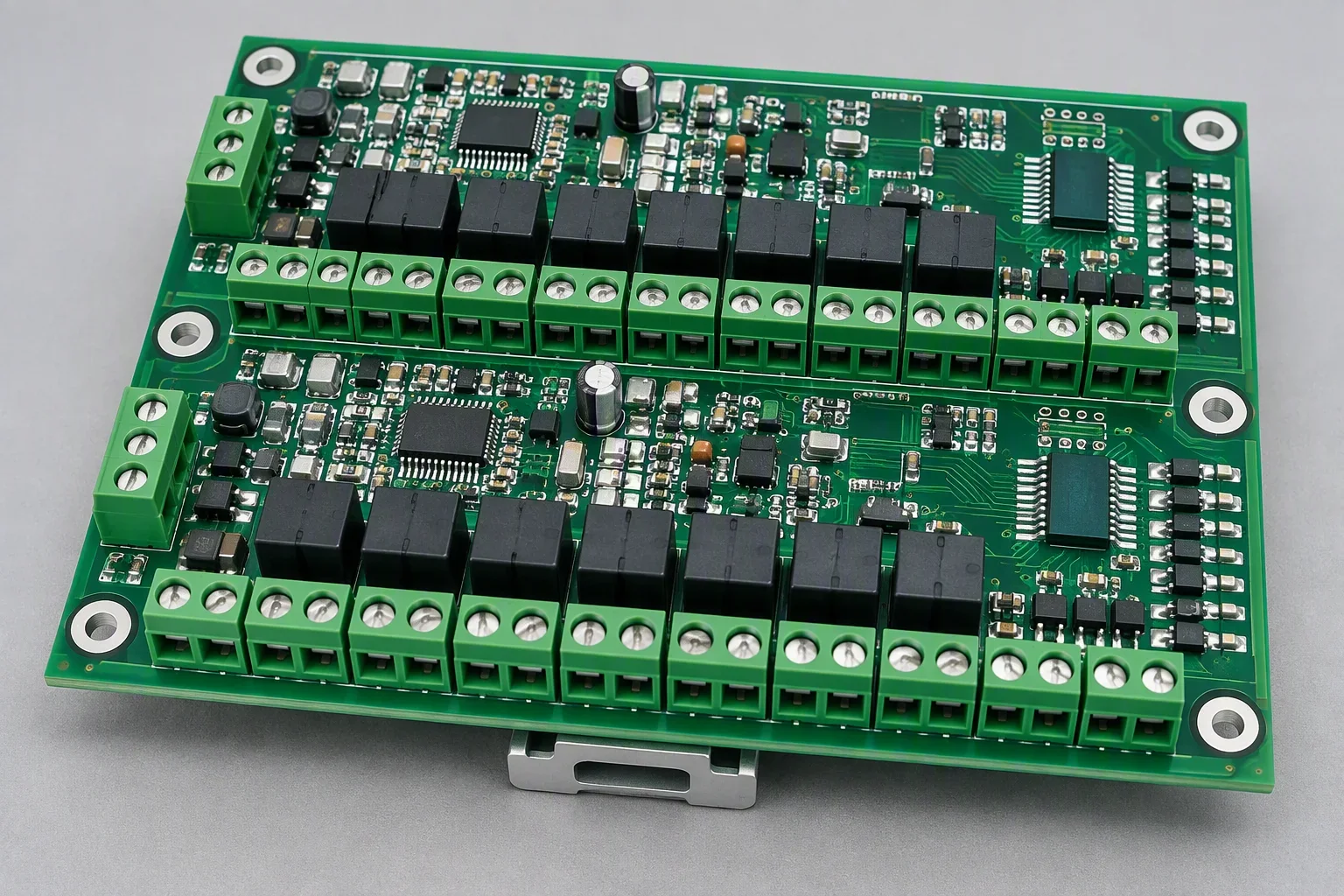
A familiar project family: access controllers, building gateways
and eight-channel 24 V distribution boards that have to mount on a DIN rail,
take field wiring at a terminal block and stay orderable for a decade.
Requirement. An isolated KNX or RS-485 front end, a relay bank driven from a 24 V field supply, wide-temperature components, and a board outline that fits a DIN-rail carrier with the terminals reachable after assembly.
Solution. The field side was partitioned from logic across all layers, surge protection was reserved at each connector, relay and 24 V paths were laid out on 2 oz copper, and the assembly was selectively coated with the terminal blocks masked.
Outcome. 100% AOI coverage, X-ray on a minimum of 5 pieces per lot, functional test to a product-specific fixture with 100% of units verified, and each unit serialised and photographed for the traceability file.
Tell us which bus interfaces the board carries, the build class the
listing requires and the annual volume you expect over the product life. We will
answer with the ten-year supply plan alongside the price.