FAQ · Packing
How the boards are packed
Moisture barrier, static control and the carton evidence that travels with the lot.
Packing evidence
Transport damage is a packing spec, not luck
The shipping matrix above reduces packing to one line. Here is what that line actually means, and why each layer exists.
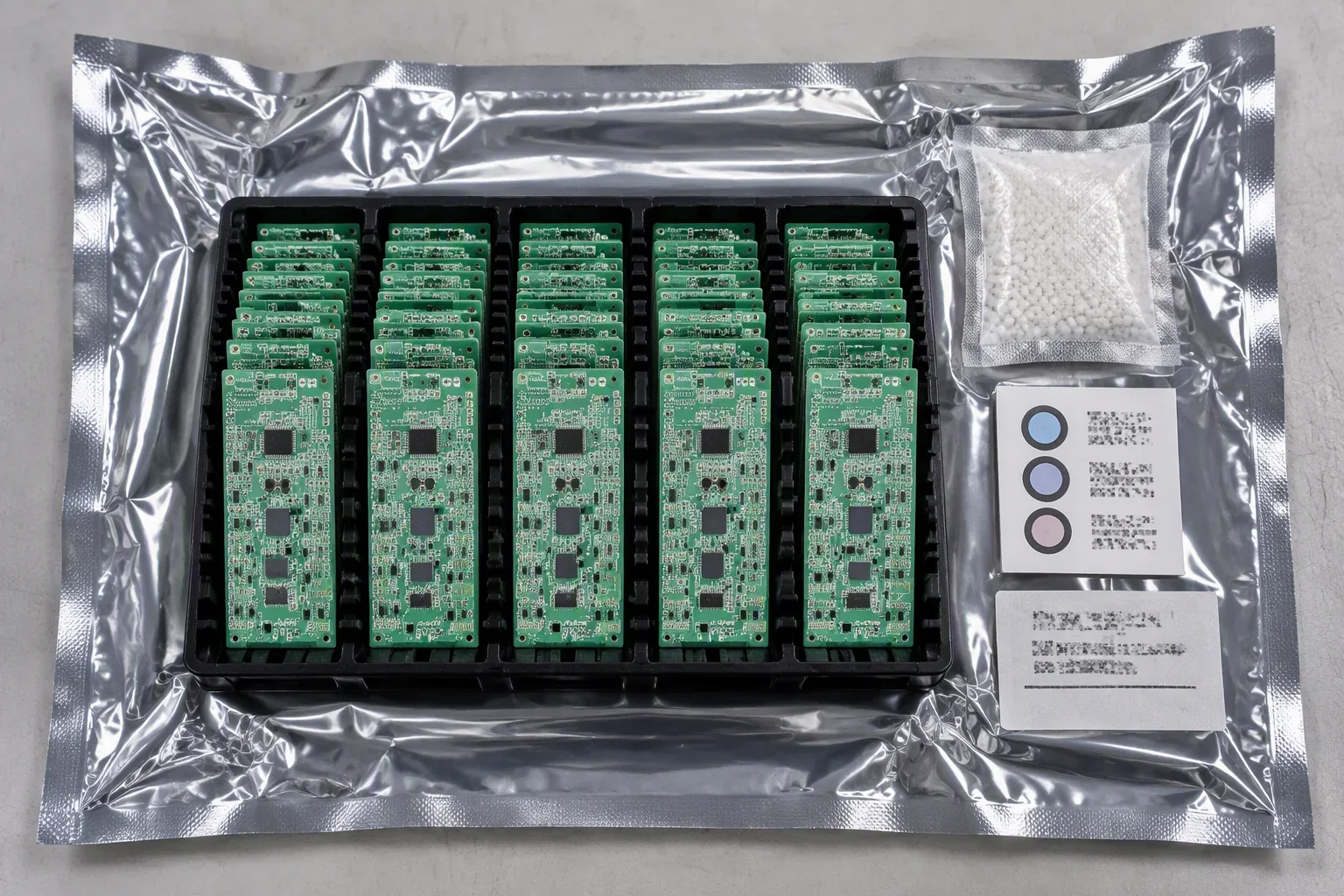
- Moisture-barrier bag, vacuum sealed. Inside it, a desiccant pack and a humidity indicator card. The bag stops ambient humidity reaching the boards between our dock and your reflow oven.
- Metallised static-shielding bag. A multi-layer metallised shield. Explicitly not the pink anti-static type, which is dissipative but has no shielding layer and will not protect a board from a discharge outside the bag.
- Dry-pack label. States the MSL level and the seal date, so your receiving inspection knows the clock that started on the day the bag was closed.
- Floor life and rebake. MSL 3 gives 168 hours and MSL 5a gives 24 hours after opening. A part that exceeds its floor life is rebaked at 125 °C for 9 hours when its body is 1.4 mm or less.
- Trays and dividers. Boards are stacked in trays with dividers so nothing abrades, and the carton is stored below 40 °C and under 90% relative humidity.
Outer packing
From the bag to the pallet
The inner packing protects the board from moisture and static. The outer packing protects it from the journey, and it is the part a receiving inspection actually checks first.
- Carton
- Double-wall corrugated, ISTA 1A drop-tested from the packed weight, with the drop height set by that weight rather than by a fixed number
- Void fill
- Boards cannot move inside the carton; every void is filled, and no board touches the carton wall
- Stacking
- Compression limit and maximum stack count printed on the carton, so a pallet is not built past what the bottom carton is rated for
- Pallet
- Heat-treated timber to ISPM 15 with the IPPC mark burned in, or a plastic pallet where the destination country restricts solid wood
- Marking
- Part number, quantity, lot, MSL level, seal date, gross and net weight, and the country of origin on every carton
- Storage
- Below 40 °C and under 90 % relative humidity, in the sealed bag, until the floor-life clock starts at opening
On arrival
What to check before you open the bag
Three checks take a minute at goods-in and decide whether the boards go straight to the line or into a rebake first.
- Read the humidity indicator card before opening. The card sits inside the barrier bag and shows the peak humidity reached in transit. A card still in its dry band means the desiccant held.
- Check the seal date against your production date. The dry-pack label carries both the MSL level and the seal date, so the floor-life clock is arithmetic rather than a guess.
- Photograph anything that looks wrong before disturbing it. A crushed carton or a breached bag is worth a photograph at goods-in; it is much harder to attribute after the boards are on the line.
Not answered here?
Eighteen answers across five pages. The rest are one click away.